
When Abdul Wahab Hassan converted from Islam to Christianity five years ago, his life changed.
Hassan now volunteers his time at Along Living Faith, a Pentecostal church just outside of Kubwa – a district close to the capital, Abuja. On a typical day, he might be walking the community talking to people about his faith, helping children on the street, or directing traffic at busy intersections.
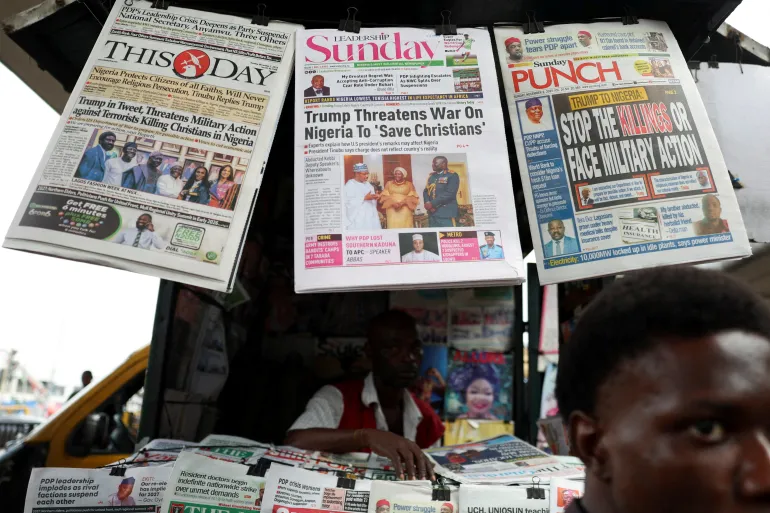
The Nigerian government’s treatment of its Christian population has made international headlines after US president Trump accused the country of a ‘Christian genocide’. The government in Abuja has vehemently rejected the charge.
Nevertheless, the accusation of a ‘Christian genocide’ has struck a nerve inside the country – particularly over whether the violence is deliberately targeting Christians.
Being a Christian in the Central North of Nigeria is not an easy life. Hassan says friends from his congregation are no longer attending church because they are afraid of being attacked. “We are tired of being killed. We are tired of this slaughter. We don’t have freedom anymore,” Hassan said.
Hassan has appreciated the attention brought by Trump’s comments but says the violence has been ongoing for many years and isn’t exclusively targeted towards Christians.
Insecurity in Nigeria is nothing new. The transnational militant Islamist group, Boko Haram began an insurgency campaign against the Nigerian government in the late 2000s, exploiting existing fractures to gain control and territory – primarily in the northern regions.
The second half of 2025 has seen a spike in attacks, with one recent raid on a village in the north-eastern Borno State, killing over 60 people. Armed theft and kidnapping is also on the rise, with a spate of recent and high profile kidnapping.
Amid the mounting internal and external pressure, President Bola Ahmed Tinubu has been vocal in his attempts to rein in the violence – declaring a national security emergency, ordering a military operations review in September, and most recently appealing to France for assistance.
Yet successive governments have failed to address the security issues throughout the country. And widespread perceptions and allegations of corruption have made the task even more difficult to manage.
TRUMP WEIGHING INTO AFRICA:
Why Washington is weighing in at all has added another layer to the fierce debate in Nigeria.
“Why would Trump and the US suddenly develop these other interests in Nigeria?” says Egodi Uchendu, professor of history at the University of Nigeria. “America should have done that decades back.”
Uchendu is unequivocal about what is driving the violence. “Christian genocide has been ongoing for over a decade; and, as a Christian, I have been on edge,” she said.
Ifeanyi Ezeonu, professor of sociology and criminology at Brock University agrees anti-Christian prejudice is part of it, but says fixating on religion alone ignores an underlying tension in the very formation of the state of Nigeria.
He says the violence is the “result from a horrid legacy of two predatory spectres that gave rise to the political contraption we know today as Nigeria.
These spectres were: (a) a vicious jihadist incursion into the northern part of Nigeria in the early 19th Century and (b) the British colonial occupation of the different traditional ‘nation-states’ that make up today’s Nigeria.”
“Managing the political monstrosity that emerged from these two evils has been very complicated. The situation has been worsened by the fact that organized political criminals and Islamic fundamentalists have seized the apparatuses of the state for over four decades.”
Hassan doesn’t see a great deal of change on the horizon, and expects little from the government. “They know what is happening, but they don’t want to tackle it” he said.
Leave a Reply